
925 Sterling Silver Manufacturing for Private Label
A private-label silver programme is a calendar problem before it is a design problem. TTT Jewelry publishes 48 hours for CAD, 25–30 days for a master sample and 21–28 days for bulk, which adds up to 48–60 days from approved brief to delivery, with a 50-piece minimum per design.

Key takeaways
- 48–60 days is the published span from brief to delivery, or roughly 7 to 9 weeks.
- CAD is 2 days, so 58 of the 60 slow-case days sit after the model is finished.
- Six designs at the 50-piece minimum commit 300 units, not 300 of each.
- A repeat order skips CAD and sampling, leaving 21–28 days of production.
An order for 925 sterling silver at the 50-piece minimum covers one design, so a three-design launch starts at 150 units before any plating or packaging decision is made.
The calendar starts before the mould is cut
Most launch plans are built backwards from a trade show date. The useful way to build one is forwards from the brief, because the first stage that consumes calendar time is not casting but the decision about what to cast.
CAD modelling takes under 48 hours once a brief is complete. The qualifier matters: a brief with a reference image, a metal call, a stone call and a target retail price produces a model in two days. A brief that arrives in three emails over a fortnight produces a model in two days plus a fortnight.
Sampling is where the schedule really sits. The master physical sample takes 25–30 days, and nothing about a digital model shortens that, because a master has to be grown, cast, cleaned, set and finished before anyone can wear it. Buyers who treat sampling as a formality tend to be the ones who discover a comfort problem in week five.
Private label adds one more constraint: the design has to be exclusive. The published commitment is a 100% NDA, with tooling, drawings and the collection kept off the factory's other client list. Exclusivity is a schedule item too, because a mould reserved for one brand cannot be shared to fill capacity elsewhere.
Where 48 to 60 days actually goes
The three published durations stack rather than overlap. CAD precedes the master, and the master precedes bulk, so the fastest credible path is 2 + 25 + 21 = 48 days and the slowest is 2 + 30 + 28 = 60 days.
| Stage | Published duration | Running total, fast case | Running total, slow case |
|---|---|---|---|
| 3D CAD modelling | Under 48 hours | Day 2 | Day 2 |
| Master physical sampling | 25–30 days | Day 27 | Day 32 |
| Sample approval by buyer | Buyer-controlled | Day 27+ | Day 32+ |
| Mass production | 21–28 days | Day 48 | Day 60 |
| Final QC and dispatch | 100% inspected | Day 48+ | Day 60+ |
The buyer-controlled row is the one no factory can publish. Approval can take a day or three weeks, and every day of silence moves the delivery date. A launch calendar that gives the internal approver no slot is a calendar with an unpriced risk in it.
The table also shows why reorders behave differently. A repeat of an approved design has no CAD and no sampling, so it runs 21–28 days. That is roughly half the first-order span, which is the real reward for keeping a design in the range instead of replacing it every season.
Running six designs through one sampling window
Six designs do not require six sampling windows. They require six briefs that arrive together, because a factory can develop several masters in parallel and only the approval decision is serial.
The MOQ of 50 pieces per design is what makes the parallel route affordable. A wholesale 925 silver jewelry factory that opens six masters at once is effectively charging six sampling efforts against 300 units, rather than one sampling effort against the same 300.
Parallel development changes the arithmetic of the minimum. At 50 pieces per design, six designs commit 300 units. That is a smaller commitment than one design at 300 pieces, and it spreads the sampling cost across a broader assortment. The trade-off is that six designs generate six approval decisions, six sets of comments and six chances of a revision loop.
A workable structure is to split the six into two groups. Four designs go first and two follow once the first samples are approved. The second group loses a little calendar time but gains the benefit of what the first group taught the buyer about fit and finish.
Buyers sourcing from a TTT Jewelry programme of this shape should ask for one project manager rather than a shared inbox, because the coordination cost of six parallel masters is where small orders go wrong. A single named contact who can report the status of each design on the same day is worth more than a marginally faster mould.
Handover: files, moulds and the packing list
The end of a private-label order is not delivery. It is the handover of everything the next order depends on: the approved CAD revision, the master sample, the plating recipe, the mould location, the pack artwork and the barcode data.
Files should be named by design code and revision, not by date. A folder of files called final, final2 and final_use_this is a folder that will cost someone a week within a year. The revision that cut the production mould is the only revision that matters, and it should be identifiable without opening anything.
Packing is the stage buyers under-plan. The published options include metallic logo tags, foil-stamped gift boxes, velvet or microfibre pouches, display backing cards and barcode labelling. Each is a separate print item with its own lead time, and each has to be matched to the right design at the packing bench.
Where a brand also sells steel, the handover pack should keep the two material streams apart. A stainless steel jewelry manufacturer will use PVD rather than electroplating, and mixing care instructions or marks between the two ranges creates a support problem after launch.
Worked example
Take a six-design silver launch at the 50-piece minimum: 6 × 50 = 300 pieces. Budget 48–60 days. If the brief is approved on 1 March, the fast case delivers around 17 April and the slow case around 29 April, before any buyer approval delay.
Now model the delay. If sample approval takes 10 days instead of 1, the fast case moves from day 48 to day 57 and the slow case from day 60 to day 69. Ten days of internal review consumes roughly a sixth of the entire fast-case calendar.
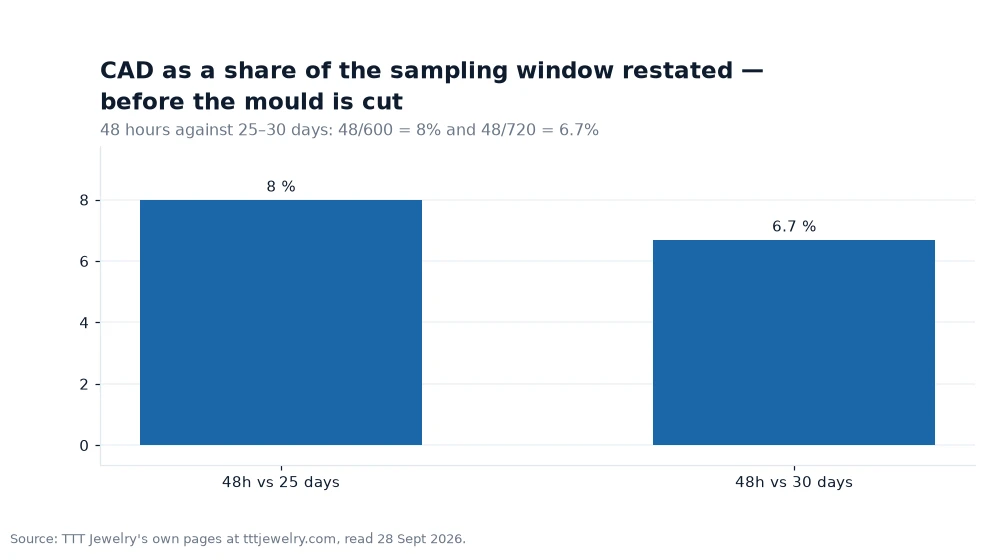
Put CAD in proportion while the numbers are open. Two days of CAD against a 25-day sample window is 48/600 hours = 8%; against 30 days it is 48/720 = 6.7%. The modelling step is not where a launch slips.
Finally, compare the repeat. A second run of the same six designs at 50 pieces each is 300 units and 21–28 days, with no CAD and no sampling. Two seasons on the same six designs therefore cost 48–60 days once and 21–28 days thereafter, which is the shortest calendar a private label can buy.
Frequently asked questions
How long does a private-label silver order take?
Plan for 48–60 days from approved brief: under 48 hours for CAD, 25–30 days for the master sample and 21–28 days for mass production.
How many pieces must a first silver order contain?
The published minimum is 50 pieces per design, so the smallest viable collection is one design at 50 units.
Do reorders need new sampling?
No. A repeat of an approved design skips CAD and sampling and runs through bulk production in 21–28 days.
Planning the second season while the first ships
The most useful time to brief the next collection is while the current one is in production, because the moulds and the fit knowledge are both fresh. Waiting for sell-through data usually pushes the next launch past the season it was designed for.
Keep a live design register: code, mould location, plating recipe, approval date and pack artwork. It is a spreadsheet, and it turns a 60-day development cycle into a 28-day one the second time a design is ordered.
Wholesale buyers who manage several brands under one roof should stagger briefs rather than stacking them. Six designs in one window is efficient; eighteen in one window is a queue, and the queue is invisible until samples start arriving late.
Source note: figures come from the manufacturer's own website (tttjewelry.com), read 28 Sept 2026.[1]